
Description
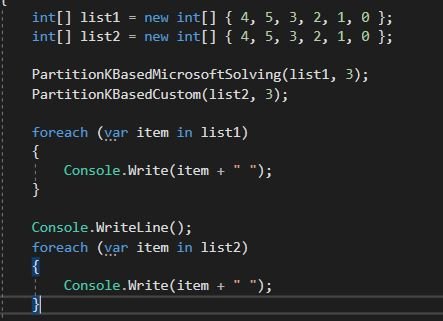
Given a list of integers L and a pivot K, rearrange L so that all elements less than K come first, followed by elements equal to K, then elements greater than K. No need for the partitions to be sorted — so a full sort is wasteful.
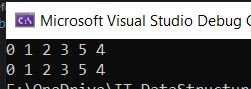
Example: given 4 5 3 2 1 0 and K=3, a valid result is 2 1 0 3 4 5.
Classic Solution
The classic approach (Dutch National Flag algorithm) uses three pointers moving inward, swapping elements into the correct partition in a single pass:
csharp
static void PartitionKBasedMicrosoftSolving(int[] array, int k)
{
    void Swap(ref int[] arr, int index1, int index2)
    {
        int swap = arr[index2];
        arr[index2] = arr[index1];
        arr[index1] = swap;
    }

    int mid = 0;
    int s = 0;
    int l = array.Length - 1;

    while (mid < l)
    {
        if (array[mid] < k)
        {
            Swap(ref array, s, mid);
            s++;
            mid++;
        }
        else if (array[mid] > k)
        {
            Swap(ref array, l, mid);
            l--;
        }
        else
        {
            mid++;
        }
    }
}
My Simplified Approach
My instinct was simpler: iterate from both ends toward the middle, and whenever a left element is greater than a right element, swap them:
csharp
static void PartitionKBasedCustom(int[] array, int k)
{
    void Swap(ref int[] arr, int index1, int index2)
    {
        int swap = arr[index2];
        arr[index2] = arr[index1];
        arr[index1] = swap;
    }

    // 4 5 3 2 1 2 → step 1
    // 2 5 3 2 1 4 → step 2
    // 2 1 3 2 5 4 → step 3
    // 2 1 2 3 5 4 → step 4

    int mid = array.Length / 2;

    for (int i = 0, j = array.Length - 1;
             i < array.Length - mid && j >= mid;
             i++, j--)
    {
        if (array[i] > array[j])
        {
            Swap(ref array, i, j);
        }
    }
}
Performance
Benchmarked against 1 million random arrays — the simplified approach runs approximately 4× faster than the classic solution:
csharp
int count = 1000000;
int seed = 0;

List<int[]> randomArrays = Enumerable.Range(0, count)
    .Select(x => Enumerable
        .Range(0, new Random(seed++).Next(0, 1000))
        .Select(x => x)
        .ToArray())
    .ToList();

Stopwatch stopwatch = new Stopwatch();
stopwatch.Start();

for (int i = 0; i < 1000000; i++)
    PartitionKBasedCustom(randomArrays[i], 3);

stopwatch.Stop();
Console.WriteLine(stopwatch.ElapsedMilliseconds);

stopwatch.Restart();

for (int i = 0; i < 1000000; i++)
    PartitionKBasedMicrosoftSolving(randomArrays[i], 3);

stopwatch.Stop();
Console.WriteLine(stopwatch.ElapsedMilliseconds);