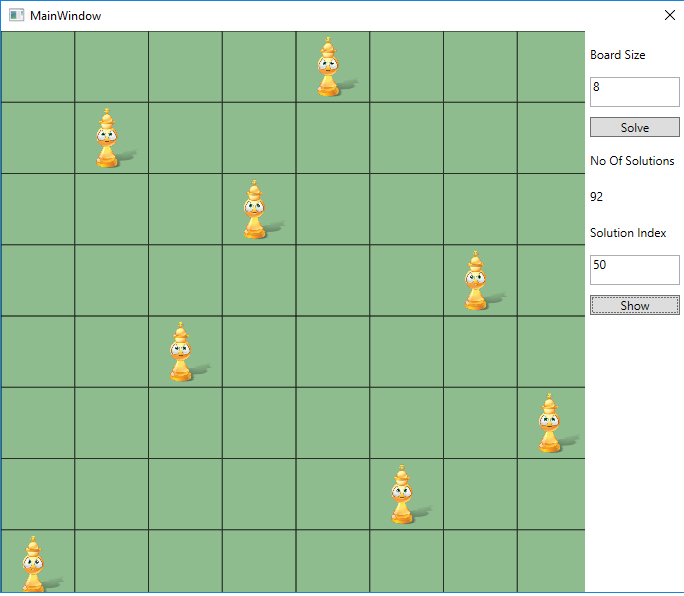
Backtracking is a general algorithm for finding all solutions to a constraint satisfaction problem. It builds candidates incrementally and abandons a candidate as soon as it determines the candidate cannot lead to a valid solution. The N-Queens problem asks: place N queens on an N×N chessboard so that no queen can attack another — no two queens share the same row, column, or diagonal.
Safety Check
Before placing a queen, verify that no existing queen occupies the same column or either diagonal above the current row:
// Returns true if placing a queen at (row, column) is safe.
// Checks the column above and both diagonals.
private bool IsSafe(char[,] board, int row, int column)
{
    // Same column — check all rows above
    for (int i = 0; i < row; i++)
        if (board[i, column] == 'Q') return false;

    // Top-left diagonal (\)
    for (int i = row, j = column; i >= 0 && j >= 0; i--, j--)
        if (board[i, j] == 'Q') return false;

    // Top-right diagonal (/)
    for (int i = row, j = column; i >= 0 && j < Size; i--, j++)
        if (board[i, j] == 'Q') return false;

    return true;
}
Recursive Backtracking
Try every column in the current row. A safe placement recurses to the next row; when all N rows are filled a complete solution is saved. Backtracking resets the cell and tries the next column:
// Recursive backtracking — try every column in the current row.
// If a placement is safe, place the queen and recurse to the next row.
// When all rows are filled, record the board as a solution.
private void Solve(char[,] board, int row, int column)
{
    if (column == 0 && row == Size)
    {
        Solutions.Add(CloneBoard(board));
        return;
    }
    for (int i = 0; i < Size; i++)
    {
        if (IsSafe(board, row, i))
        {
            board[row, i] = 'Q';
            Solve(CloneBoard(board), row + 1, 0);
            board[row, i] = '-';  // backtrack
        }
    }
}
Complete Solution
The NQueens class collects every valid board state in Solutions and provides a pretty-printer. Queens are represented as 'Q' and empty squares as '-':
public class NQueens
{
    public int           Size           { get; }
    public List<char[,]> Solutions      { get; } = new List<char[,]>();
    public int           SolutionsCount => Solutions.Count;

    public NQueens(int size) => Size = size;

    public void SolveNQueens()
    {
        char[,] board = new char[Size, Size];
        for (int i = 0; i < Size; i++)
            for (int j = 0; j < Size; j++)
                board[i, j] = '-';
        Solve(board, 0, 0);
    }

    public void PrintSolution(int index)
    {
        var sb = new StringBuilder();
        for (int i = 0; i < Size; i++)
        {
            for (int j = 0; j < Size; j++)
                sb.Append(Solutions[index][i, j]).Append(' ');
            sb.AppendLine();
        }
        Console.Write(sb);
    }

    private bool IsSafe(char[,] board, int row, int col)
    {
        for (int i = 0; i < row; i++)
            if (board[i, col] == 'Q') return false;
        for (int i = row, j = col; i >= 0 && j >= 0; i--, j--)
            if (board[i, j] == 'Q') return false;
        for (int i = row, j = col; i >= 0 && j < Size; i--, j++)
            if (board[i, j] == 'Q') return false;
        return true;
    }

    private char[,] CloneBoard(char[,] board)
    {
        var copy = new char[Size, Size];
        for (int i = 0; i < Size; i++)
            for (int j = 0; j < Size; j++)
                copy[i, j] = board[i, j];
        return copy;
    }

    private void Solve(char[,] board, int row, int col)
    {
        if (col == 0 && row == Size) { Solutions.Add(CloneBoard(board)); return; }
        for (int i = 0; i < Size; i++)
        {
            if (IsSafe(board, row, i))
            {
                board[row, i] = 'Q';
                Solve(CloneBoard(board), row + 1, 0);
                board[row, i] = '-';
            }
        }
    }
}
Usage
An 8-Queens problem has 92 distinct solutions:
NQueens nQueens = new NQueens(8);
nQueens.SolveNQueens();
Console.WriteLine(quot;Solutions: {nQueens.SolutionsCount}");  // 92

nQueens.PrintSolution(0);   // first solution
nQueens.PrintSolution(10);  // eleventh solution